The Evolution of the Smart Factory and New Possibilities for High-Value-Added Printing - Komori Global Open House 2026 Report
11 November 2026
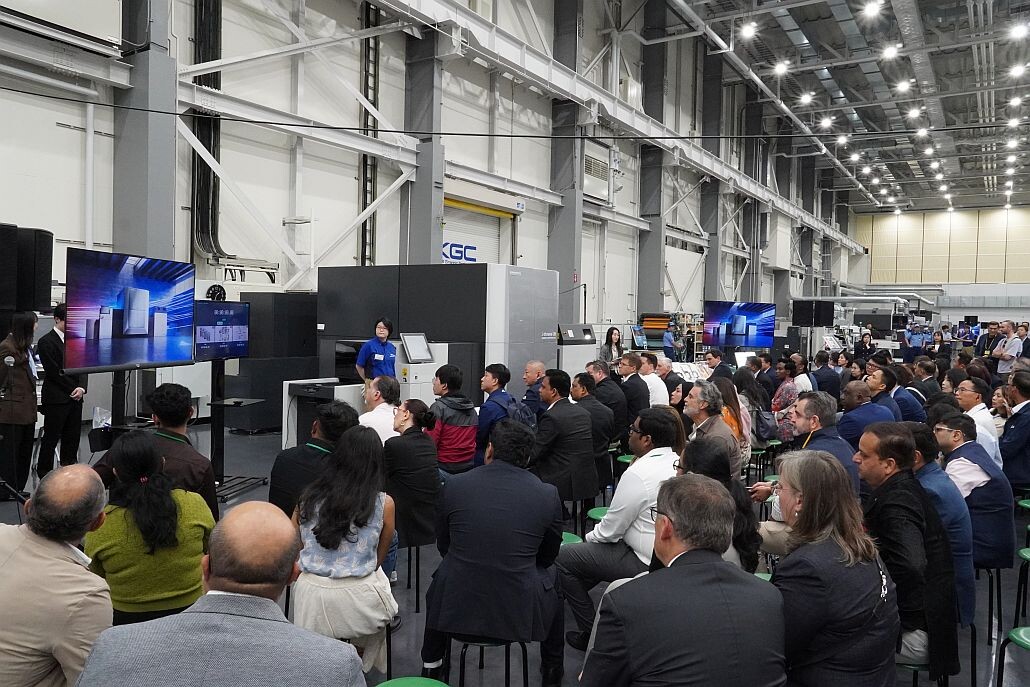
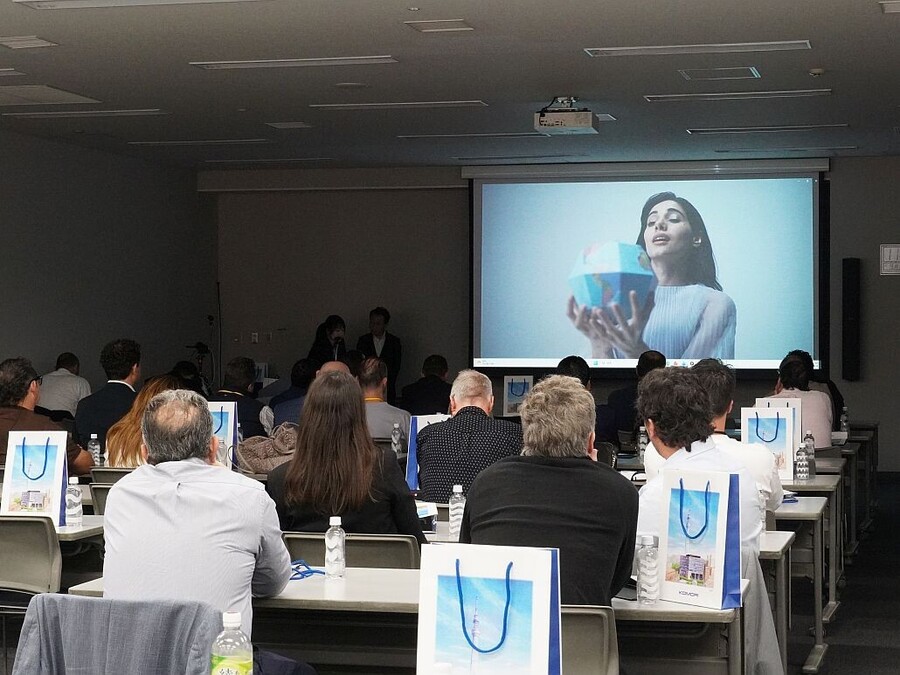
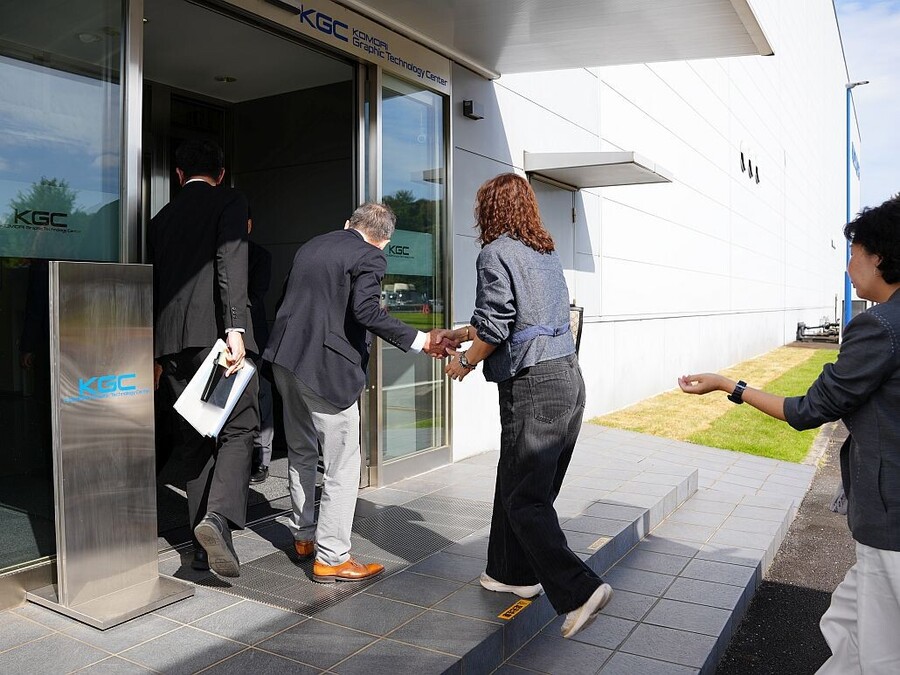
From October 19 to 20, 2026, Komori held the "Komori Global Open House 2026" for overseas customers at the KGC (Komori Graphic Technology Center) in Tsukuba Plant, Japan. During the event, 100 customers from 15 countries attended the event, and through live demonstrations, Komori proposed the latest solutions that transform printing technology into customer profitability.
The printing industry today faces increasingly complex challenges, including labor shortages, rising costs, and growing demands for higher quality. From the perspective of "how to create an environment where people can devote their efforts to higher-value work," Komori is committed to improving value-added labor productivity.
On Day 1, under the theme of "The Future of the Printing Factory," Komori presented its vision for the future of printing and its concept of the Smart Factory. The company also showcased the latest technologies supporting this vision - leveraging DX (Digital Transformation), FA (Factory Automation), and AI - through demonstrations on three printing presses.
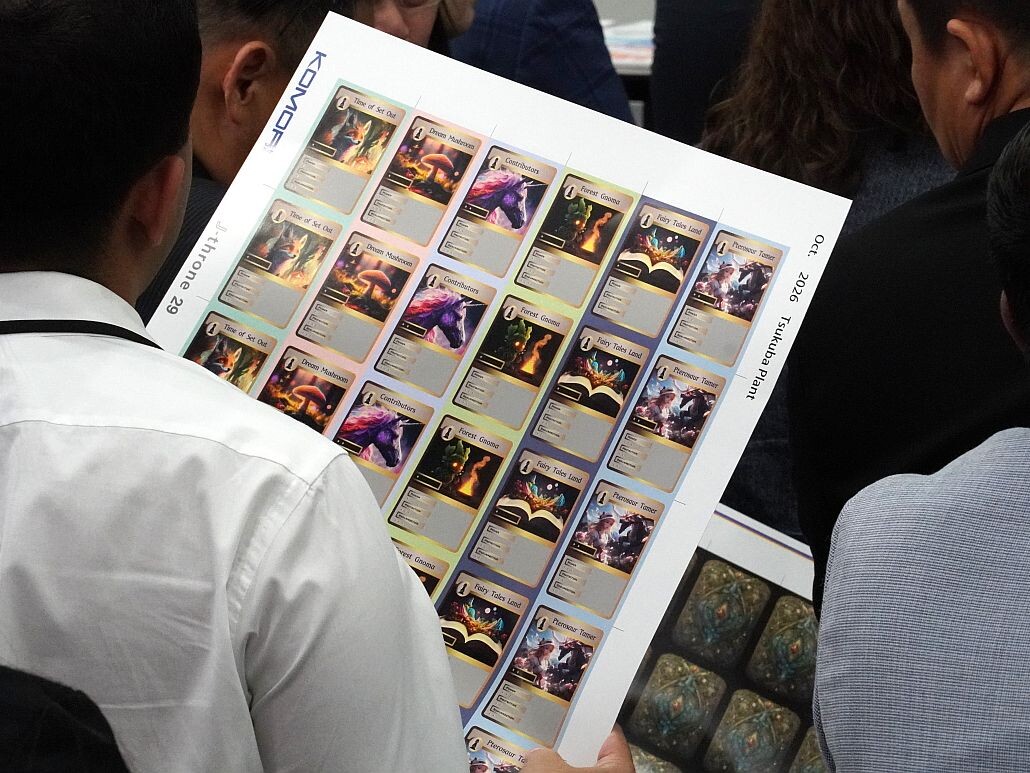
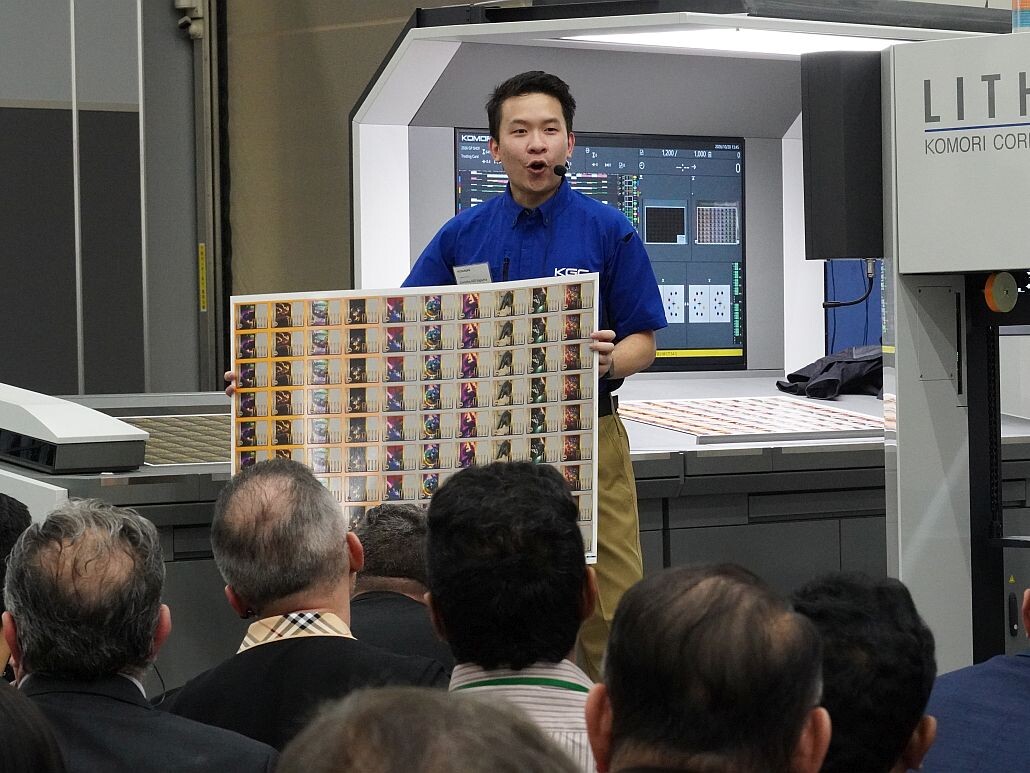
On Day 2, seminars and demonstrations were held focusing on trading card printing and high-value-added printing. Attendees saw firsthand how Komori's printing technology contributes to improved productivity and profitability for customers.
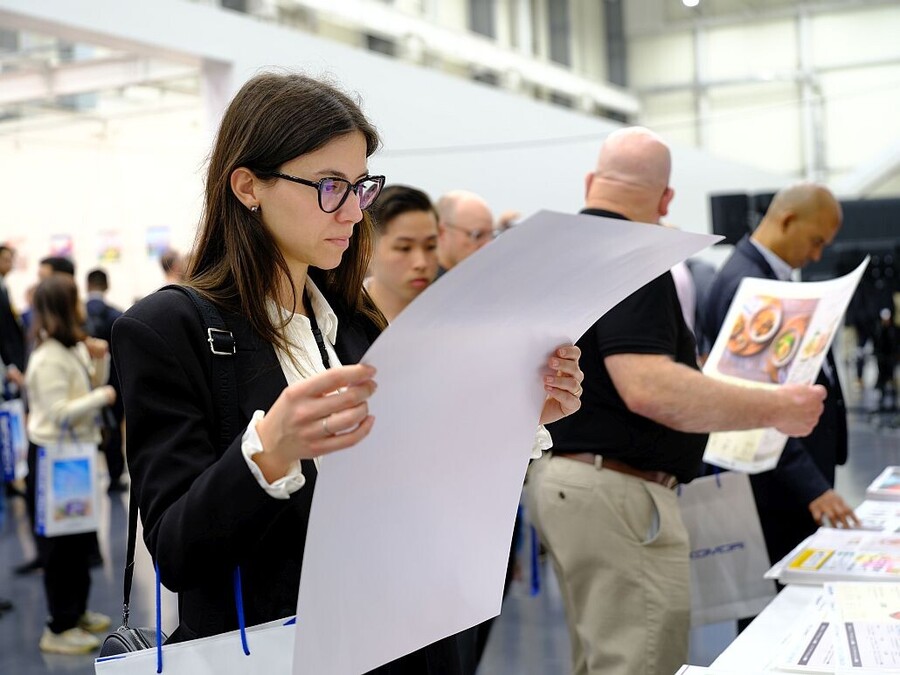
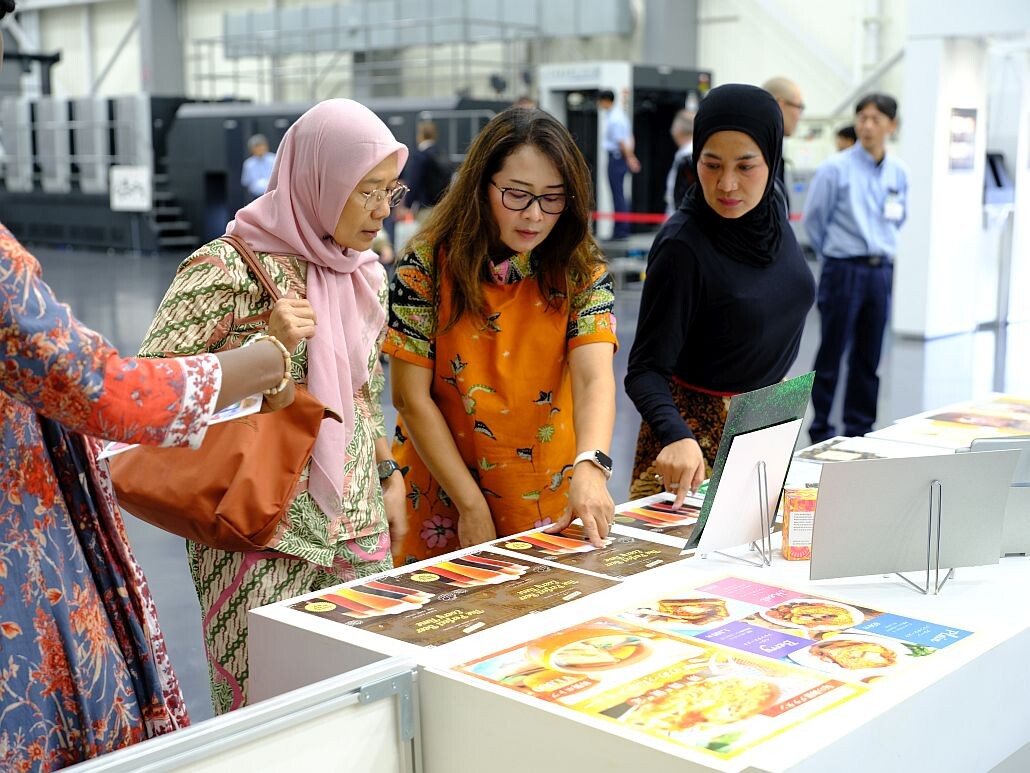
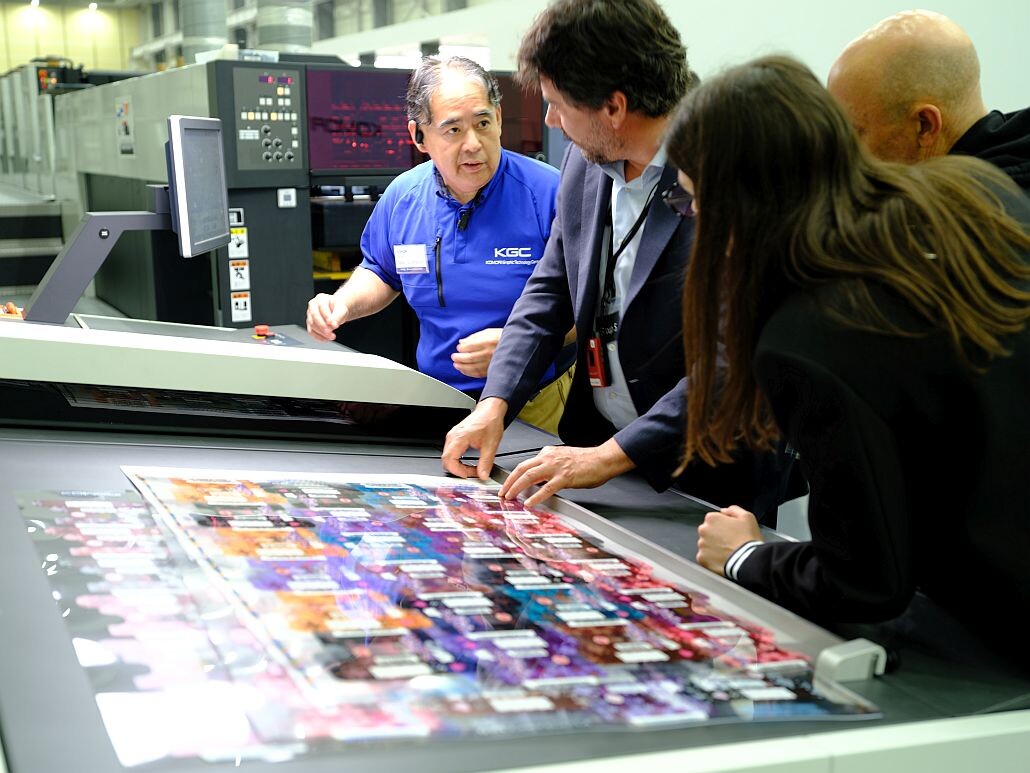
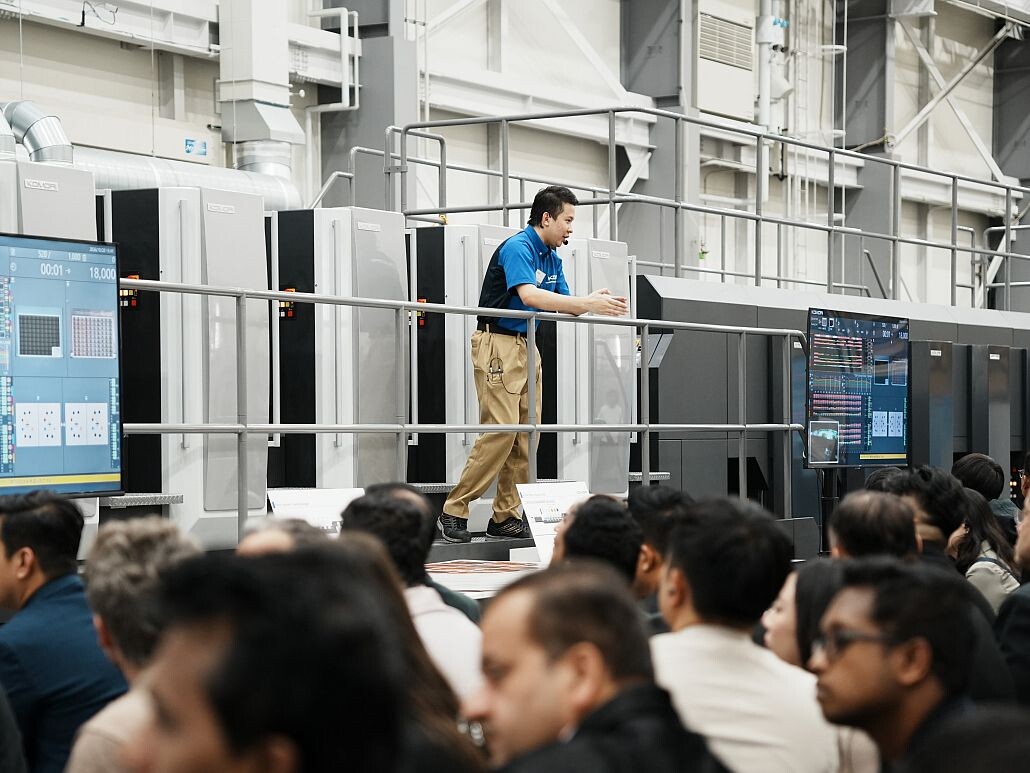
The venue was filled with lively exchange, as visitors shared insights with one another and with staff in front of the presses and printed samples. Attendees were seen actively discussing how to apply the latest technologies on their own shop floors, creating a vibrant atmosphere throughout the event.
From Press Optimization to Whole-Factory Optimization
The Smart Factory envisioned by Komori is a framework that captures the entire flow - from order intake through prepress, press, postpress, and logistics - as a single stream, optimizing the factory as a whole. Built on three pillars - equipment automation, process visualization, and streamlining across all processes - it reduces "waiting time" for people and jobs as well as "waste between processes."
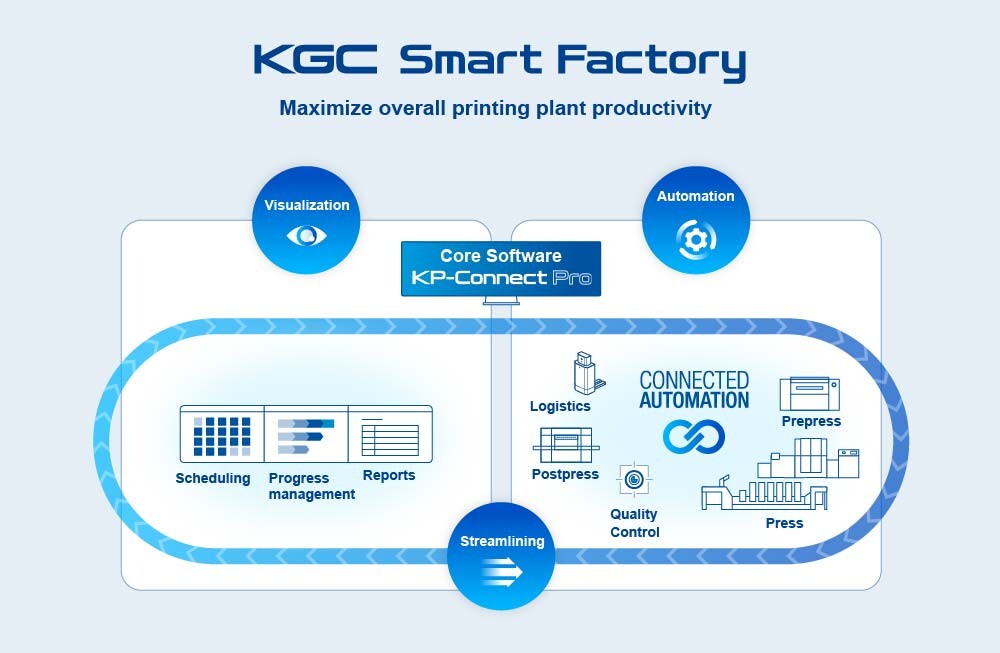
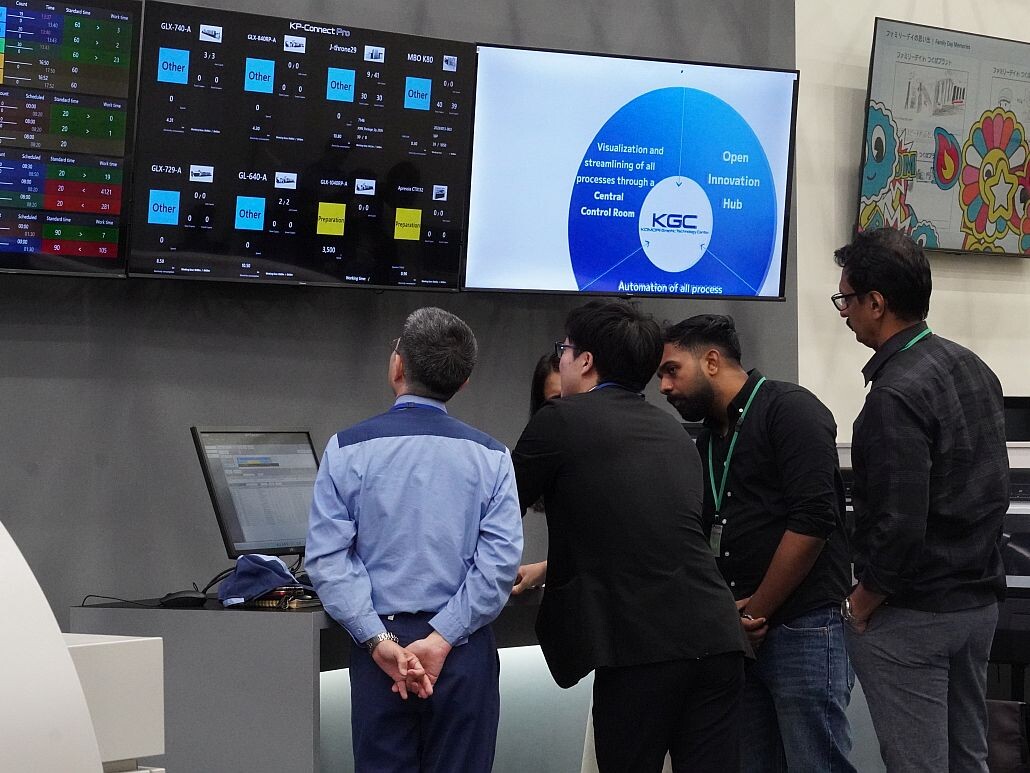
At its core is KP-Connect Pro, a Manufacturing Execution System (MES), which centrally manages the production schedule, progress, and results across the entire factory and supports rapid decision-making.
In each demonstration, visitors could see how job progress was linked with the central control room in KGC. With KP-Connect Pro, the schedule, in-progress status, and completion of each process - from prepress through press and postpress - are visualized on large monitors and shared throughout the factory. The system also supports visualization of environmental data such as power consumption, ink usage, and CO₂ emissions. Komori introduced a framework that reduces bottlenecks and makeready waste between processes and supports efficient production across the entire factory.
By connecting information through DX, linking processes through FA, and supporting decision-making with AI, Komori aims to improve not only productivity, but also work styles and the value delivered to customers.
Demonstration 1: A Production Site Where AI, the Press, and People Work Together
●Press : Lithrone G40 advance(40" Offset Printing Press)
●Job:Cosmetic Package
●Paper:Coated paperboard
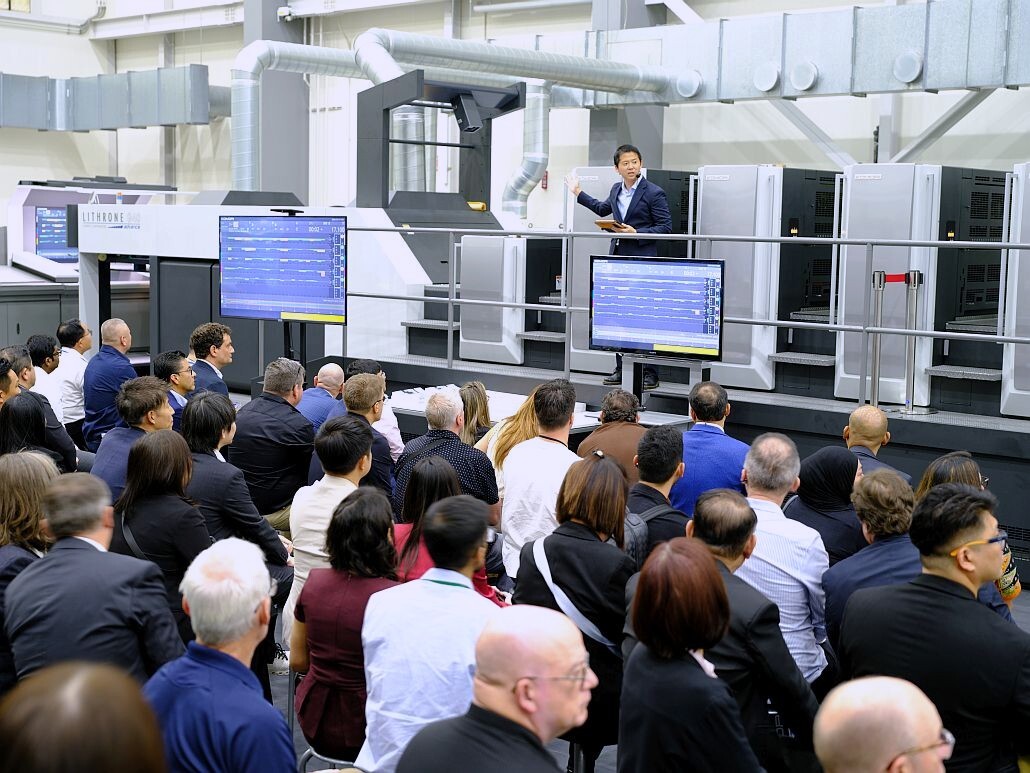
The Lithrone G40 advance demonstration presented a new vision of the pressroom in which the press, AI, and people work in collaboration.
During production printing, the inline quality control device PQA-S (Print Quality Assessment System for Sheetfed) inspected every sheet, while AI analyzed and classified detected defects. Komori showcased technology that supports operators in making appropriate decisions. In addition, the company introduced technology that accumulates inspection results and applies them to quality control and troubleshooting.
Komori's goal is not to replace people, but to enhance human value - and to have AI, the press, robots, and people work together. By allowing people and automation technology to each play their respective roles, Komori demonstrated the direction of its Smart Factory: reducing workload while achieving stable production that is less dependent on operator experience.
Demonstration 2: High-Value-Added Printing with a Double Coater
●Press: Lithrone GX40 advance(40" Offset Printing Press)
●Job:Whisky Package
●Paper:Coated Paperboard
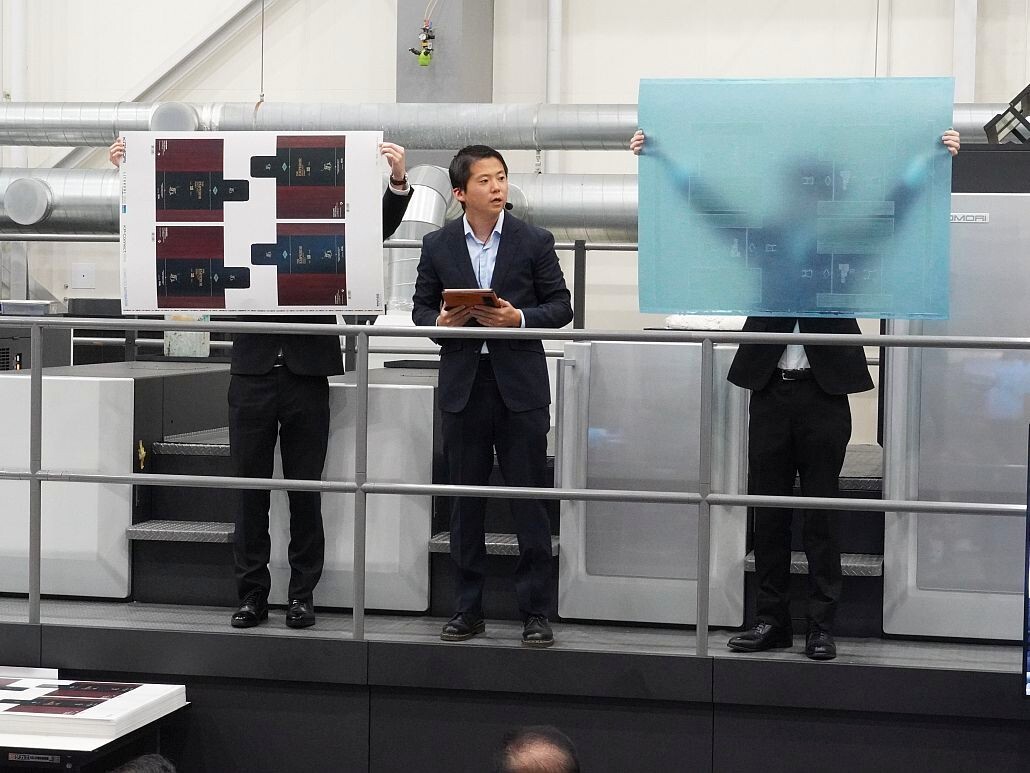
On the Lithrone GX40 advance, Komori showcased high-value-added printing using a double coater. After conventional ink printing, the first coater applied an aqueous primer, and the second coater applied UV spot coating - enabling premium decorative finishing in a single pass. During printing, PQA-S inspected every sheet to detect contamination and defects. By combining a double coater and an inspection system in a single press, customers can take on more profitable print jobs.
Demonstration 3: Versatility Across a Wide Range of Substrates and Efficiency for High-Mix, Small-Lot Production
●Press:J-throne 29(29-inch Sheetfed UV Inkjet Digital Printing Press)
●Job:① Posters, ② Book interiors, ③ Flyers, ④ Menus, ⑤ Trading cards, ⑥ Product packaging
●Paper:① Matte paper, ② Uncoated paper, ③ Coated paper, ④ Synthetic paper, ⑤⑥ Thick stock
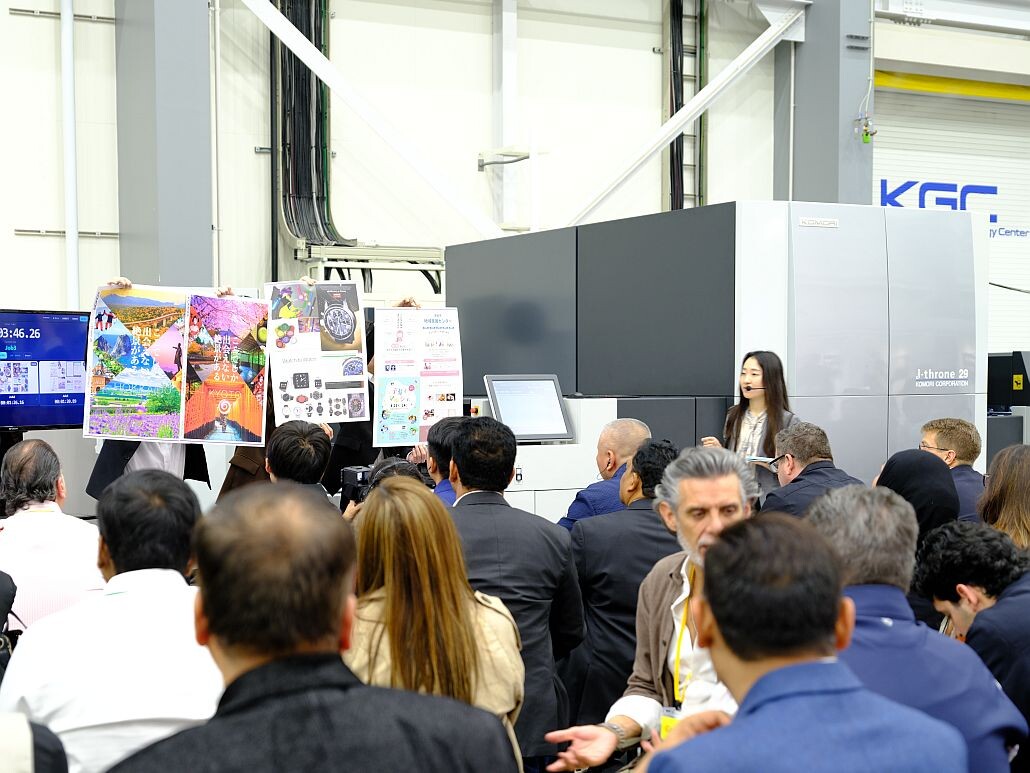
The 29-inch Sheetfed UV Inkjet Digital Printing Press "J-throne 29" supports production speeds of 6,000 sheets per hour in simplex printing and 3,000 sheets per hour in duplex printing. For duplex printing, the press employs a perfecting mechanism and sheet transport technology cultivated through Komori's offset presses, achieving highly accurate front-to-back registration.
The demonstration featured the consecutive printing of three different small-lot jobs - a poster, book interior, and flyer - as well as jobs using synthetic and thick stock.
In the three-job consecutive run, the press switched between simplex and duplex while changing substrates, completing all printing in 3 minutes and 46 seconds - showcasing both productivity and smooth job changeovers.
Next, attention turned to the press's wide range of substrate compatibility. Through printing on non-absorbent substrates such as synthetic paper, the J-throne 29 demonstrated its ability to handle a variety of substrates without the need for precoating.
Additional printed samples were also displayed using a wide variety of substrates, including washi (Japanese paper), metallized paper, and PET film. Thanks to its proprietary LED-UV ink, the J-throne 29 supports printing on specialty substrates such as synthetic paper without requiring precoating.
Komori proposed a solution that balances productivity in a market trending toward smaller lots and higher mix, with the ability to deliver high-value-added printing expression.
Demonstration 4: Improving Profitability through Small-Lot, High-Value-Added Printing
●Press: Lithrone GX29 advance(29" Offset Printing Press)
●Job:Cosmetic Package
●Paper:PET film
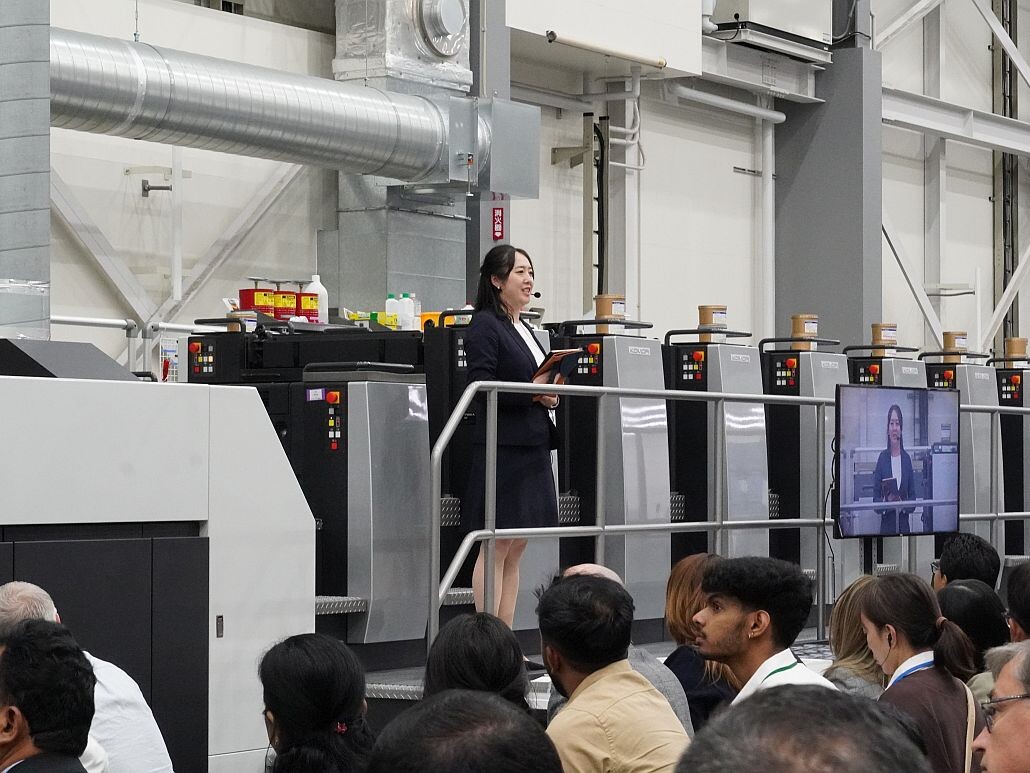
The Lithrone GX29 advance showcased solutions designed for markets that demand high added value, such as packaging and trading cards using transparent substrates. In the demonstration, the press printed cosmetics packaging on 0.3 mm transparent film, overlaying four process colors with white to make transparency itself a design element. The Lithrone GX29 advance efficiently produces work on sheet sizes optimized for each job, reducing paper waste and supporting improved profitability. For transparent substrates, which are prone to static electricity, e-Mist directly humidifies the sheet with micro-mist to support stable feeding and sheet alignment at delivery. Komori introduced a solution that enables stable production of packaging using specialty substrates.
Demonstration 5: High-Value-Added Trading Card Production with Two-Sided One-Pass Coating
●Press: Lithrone GX40RP advance(40" Dedicated Two-sided Multi-color Offset Printing Press)
●Job: Trading card
●Paper:Coated paper
Komori introduced a configuration in which two-sided coater units are mounted on the Lithrone GX40RP advance, presenting a printing solution that delivers both high-added-value and high productivity for the rapidly expanding trading card market.
In the demonstration, two-sided printing and coating were completed in a single pass, achieving high front-to-back registration accuracy and a wide range of decorative expression while maintaining productivity.
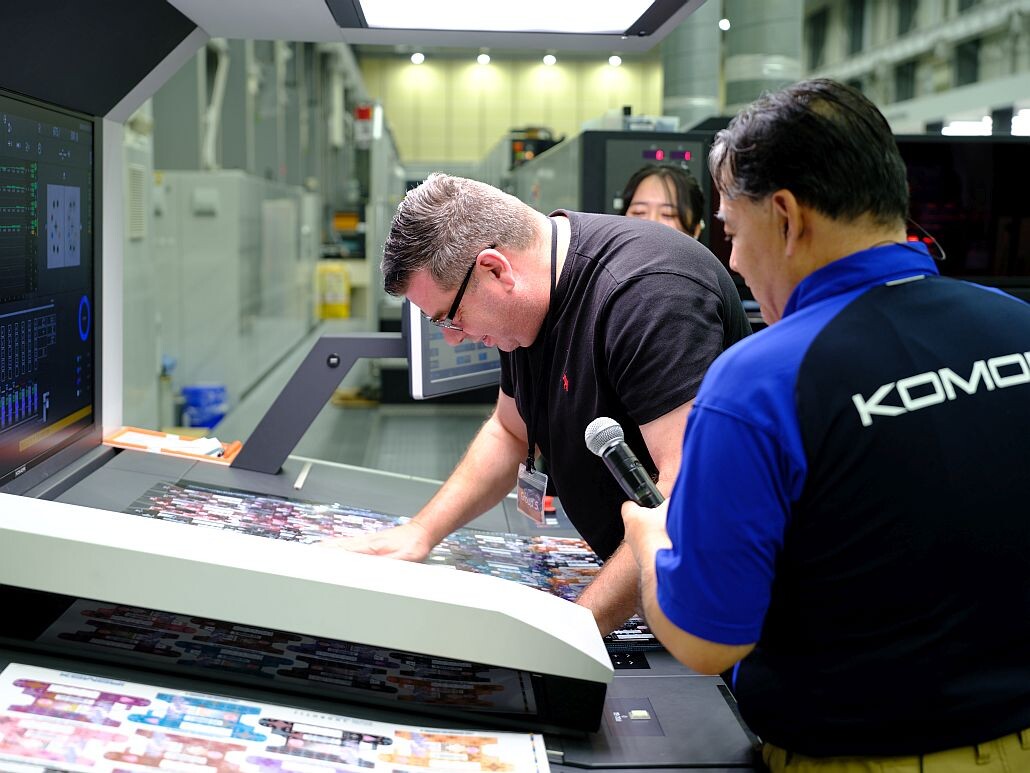
Furthermore, through 10-color simultaneous plate changing with the A-APC (Asynchronous Automatic Plate Changer), integrated control of the entire press with KHS-AI, and color and register adjustment via the PDC-SX (Spectral Print Density Control - SX model), the press transitioned smoothly to production printing while minimizing makeready time and waste paper.
Printing was performed at 18,000 sheets per hour, with PQA-S handling quality control on both the front and back sides and PDC-SX measuring in-sheet color - demonstrating a system that stably produces high-value-added trading cards.
As an additional application of the two-sided coater, Komori also displayed food packaging samples coated with aqueous barrier varnish to provide water and oil resistance to paper-based food packaging, proposing possibilities for applications beyond trading cards into other packaging fields.
Special Seminars
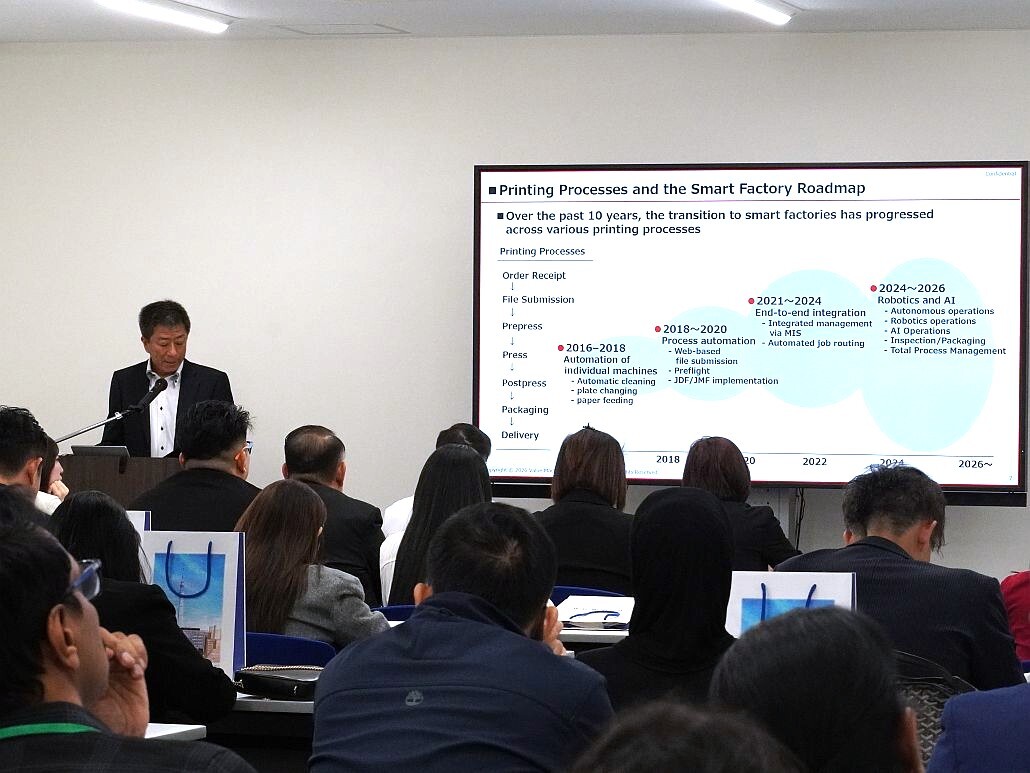
Day 1: Smart Factory Transformation as a Business Strategy - The Benefits of Automation
Day 2: Market Trends Report: Card Printing / Cardstock Printing Market
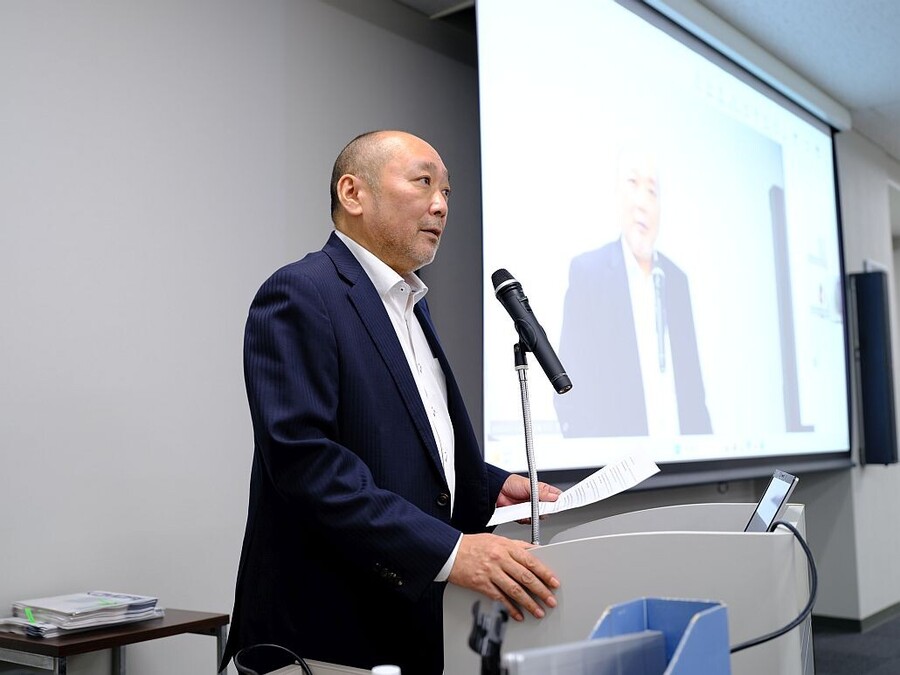
For the special seminars, Komori welcomed Mr. Yasuo Miyamoto, Director and Vice President of VMI Inc., who shared his perspective on the market environment surrounding the printing industry and the possibilities for printing businesses going forward.
On Day 1, under the theme of "Smart Factory Transformation as a Business Strategy," Mr. Miyamoto addressed challenges such as shortages of workers and skilled operators, rising costs, the shift toward smaller lots and higher mix, and shorter lead times. Using case studies from Japan and abroad, he explained that a Smart Factory leveraging automation, AI, and robotics is not an end in itself, but rather a business strategy for solving these challenges and driving sustainable growth in the printing industry.
On Day 2, he presented the latest trends in the card printing and cardstock printing markets. The lecture focused on trading cards and collectible cards - segments where growth is expected - as well as paperboard packaging and point-of-sale (POS) materials. Mr. Miyamoto also touched on finishing processes that enhance the value of printed products, such as varnishing, holograms, and foil stamping, discussing how high-value-added printing can create new business opportunities.
Voices from Customers
Terry Swade, EVP Operations, Salem One, U.S.
Seeing the additional technologies and how the presses can be configured differently was quite interesting. It gave me more ideas about what we could be doing in the future and new business opportunities I could pursue. With the AI advancements, improvements in software, and even the automatic plate changers, these are all things we will need going forward, as there will be less skilled labor available in the industry.
Ntarugera Gakire, CEO, Select Kalos Kigali, Rwanda
This is my first time in Japan, and visiting a factory like Komori has been something very special. The seminars were very clear, and during the live demonstrations, the printing speed, the quality, and the short makeready time were very impressive.
The "Komori Global Open House 2026" provided an opportunity to showcase the evolution of the Smart Factory, the latest technologies, and the possibilities of high-value-added printing through live demonstrations and seminars. We hope that participants, after returning to their home countries and regions, will take back with them the inspiration to ask themselves, "How should our own factory evolve from here?"
Komori will continue to contribute to the optimization of customers' production and the enhancement of their competitiveness through solution proposals grounded in a production floor's perspective.