Customer-First Technology Development Addressing automation, labor-saving, and increased efficiency
“Technology and Challenges as Seen Through Komori’s 100-Year History” Series (Part 2)
14 May 2026

In this series, "Technologies and Challenges Through 100 Years of Komori," we spotlight key technological innovations and business milestones from our century-long history. This article focuses on Komori's customer-first technology development, through which the company has pursued automation, labor-saving, and greater efficiency in the printing process while continuously creating world-first technologies.
●To reduce makeready time and save labor, our company has been developing automation technologies since the 1980s.
●The automatic plate changer "APC," introduced in 1990, significantly shortened operation time and received high acclaim both in Japan and overseas.
●Systems such as PQC, PDC-S, and PQA-S achieved consistent print quality and improved efficiency through remote operation.
●Automatic settings for paper size and printing pressure, along with automation of cleaning processes, dramatically reduced makeready time and promoted standardization of operations.
●KHS, which enables single-pass registration and color matching, and KHS-AI, equipped with self-learning capabilities, contributed to reducing paper waste and improving productivity.
"Technology and Challenges as Seen Through Komori's 100-Year History" Series (Part 2)
Komori has been developing automation and labor-saving technologies since the 1980s to increase work efficiency by, for example, shortening makeready time and reducing printing materials. Komori developed a series of new systems, such as the world's first Automatic Plate Changer (APC) device, achieving printing quality and productivity enhancements that exceeded customer expectations.
Komori developed world's first advanced APC technology
The Automatic Plate Changer (APC), displayed at DRUPA90 in 1990, was Komori automation technology that caused repercussions around the world. Komori developed two versions: the fully automatic Full APC and the semi-automatic Semi-APC. The APC was the world's first device that automated the complicated process of plate changing, which until then had relied on the experience of skilled operators. Manually changing the plates on a 40-inch four-color manual press took about 30 minutes, but with the Full APC, the process was completed within three minutes and plate setting accuracy was within 0.06 mm. In addition, the Semi-APC, originally developed for 26-inch presses, automated all processes other than removing the used plate and setting the new plate in the leading edge plate clamp, dramatically reducing plate changing for four colors from about 15 minutes to about two and a half minutes with setting accuracy within 0.06 mm. Despite their speed and accuracy, these APC devices could be easily operated by anyone, and by reducing variation in registration accuracy in conjunction with plate setting accuracy, shortening makeready times, eliminating the need for skilled operators, and reducing work-load, they made significant contributions to improving work environments and enhancing print quality.
The APC was acclaimed for its advanced technology and in 1991 received a Technology Award from the Japanese Society of Printing Science and Technology and the Prize of the Japan Society for the Promotion of Machine Industry. The APC was also commended in overseas printing industries, receiving the Best Printing Equipment Award from Printweek in the U.K. and the InterTech Technology Award from the Graphic Arts Technical Foundation (GATF) in the U.S. in 1993.
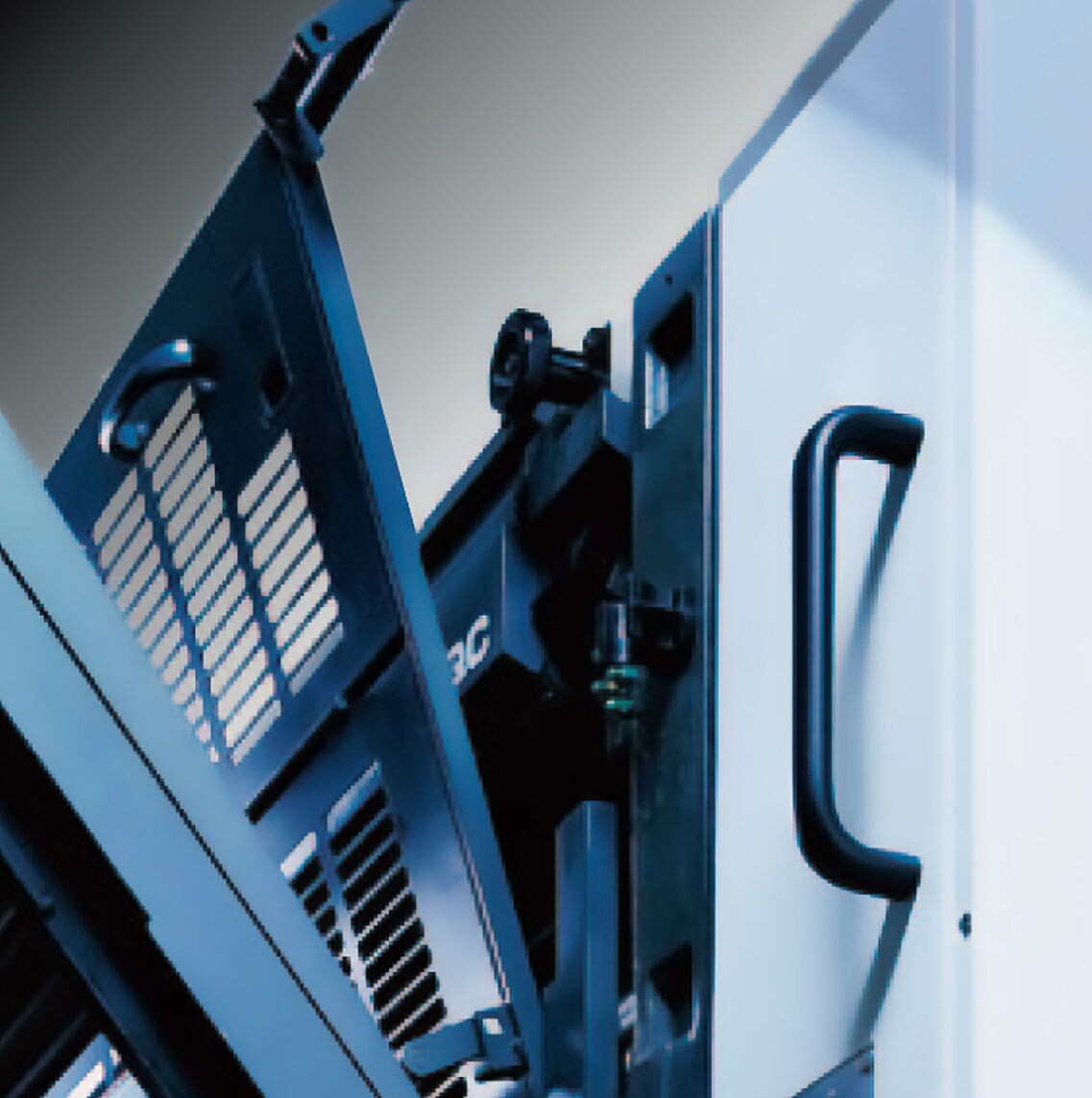
The APC captured considerable attention in Japan and overseas as first-of-its-kind advanced technology.
Komori has developed technologies and products that prioritize customers with the objectives of increasing printing performance and improving productivity. Since the 1980s, Komori has completed a variety of printing systems that address automation and labor-saving in printing operation. The Print Quality Control (PQC) system announced in 1981 was an advanced-technology device that enabled remote operation of the ink keys, ink feeding, dampening, plate register, and other aspects of printing using a remote control. Precise computer control eliminated the difficulties of water and ink adjustment and significantly shortened the time from the complicated makeready to production printing, achieving labor savings and uniform print quality. The Komorimatic, a continuous dampening system that maintains an appropriate balance of damping water and ink at all times, has become a standard device on Komori sheetfed presses. Later, as part of the PQC system, Komori developed printing automation systems with expanded functionality such as the Print Density Control-Spectro (PDC-S) to control ink density and color during printing; the Print Quality Assessment System for Sheetfed (PQA-S) to assess print quality for sheetfed presses; and the Komori Monitoring System (KMS), a printing press monitoring system.
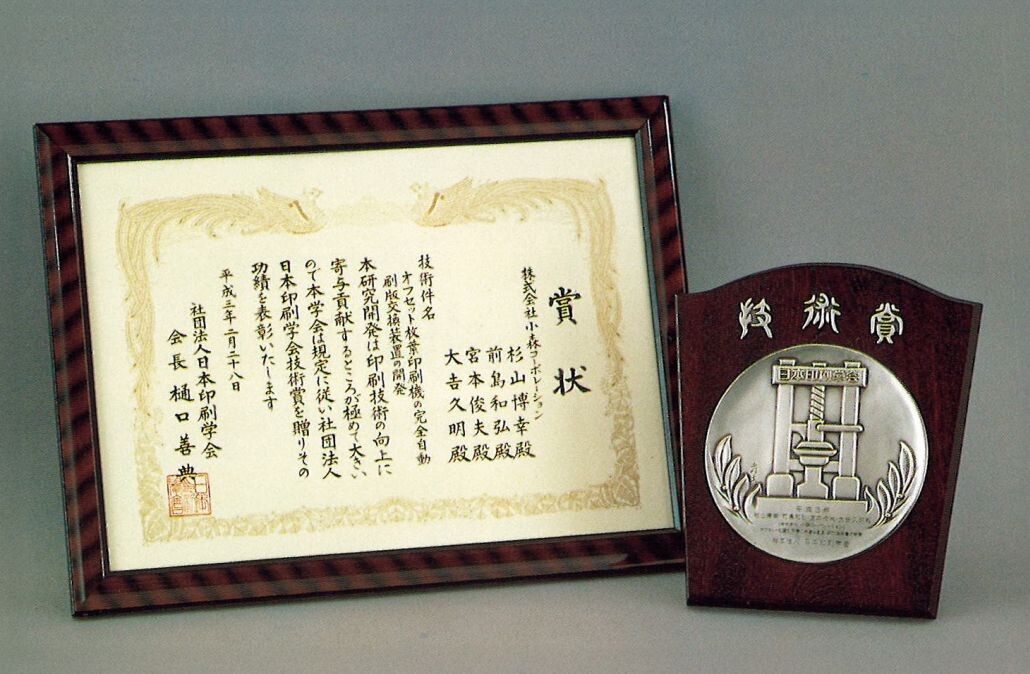
The APC received both a Technology Award from the Japanese Society of Printing Science and Technology in February 1991 and the Prize of the Japan Society for the Promotion of Machine Industry in December of that year.
AMR System raises work productivity
In parallel with the announcement of the APC, Komori developed the Automatic Make-Ready (AMR) system to improve printing operation and production efficiency. The system has a preset function that automatically sets the printing pressure on the print units using numerical data according to the feeder and delivery paper size settings and paper thickness, and also automates cleaning of the blanket cylinder, impression cylinder, and ink rollers. This automated system from Komori became at the world's highest levels. In addition, functions such as an automatic nonstop function that enabled replenishing paper on the feeder and extracting paper pile of delivery without stopping the press were also incorporated depending on the press specifications. The AMR incorporated technology to automatically control these functions according to the job conditions at the touch of a button. These preset functions reduced the time for a simple changeover on a 40-inch four-color press from an average of 17 minutes previously to just three minutes. The makeready time before starting actual printing had previously taken about 80 minutes with two operators, but by using the AMR system with APC, it could be dramatically reduced to about 15 minutes by a single operator. Moreover, individual adjustment tasks previously relied on operator experience and skill but could now be easily understood and set with high accuracy using a digital display. When performing repeat jobs, presets of the values from the prior time could be used, leading to standardization of the entire printing process and stabilization of print quality. These types of automation functions became standard on the Lithrone series of offset sheetfed presses and the System series of web offset presses.
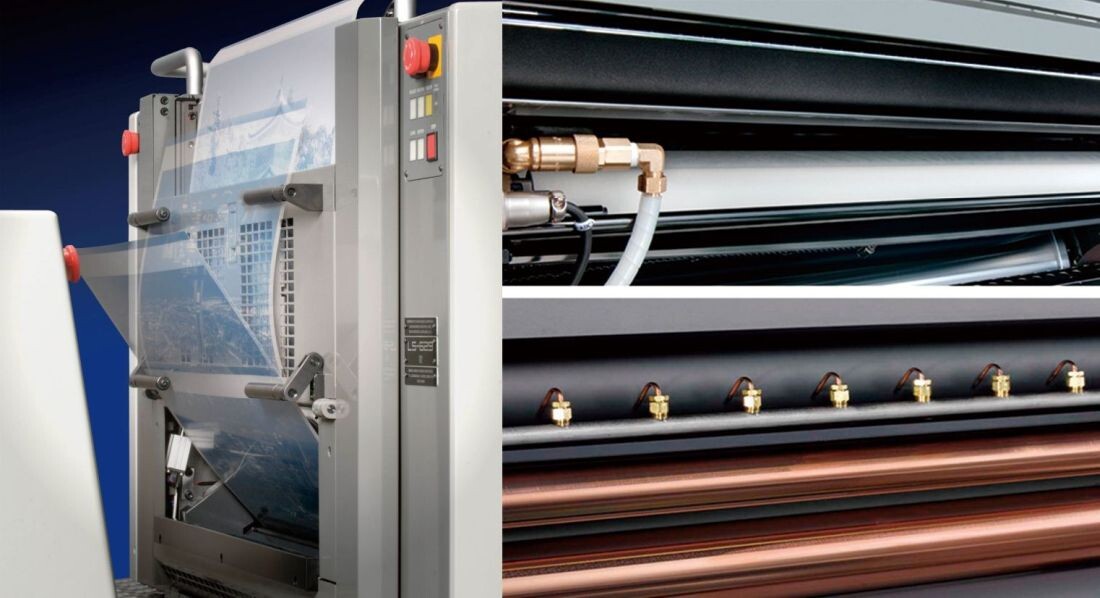
Plate changing using APC Blanket cleaning (top) and ink roller cleaning (bottom).
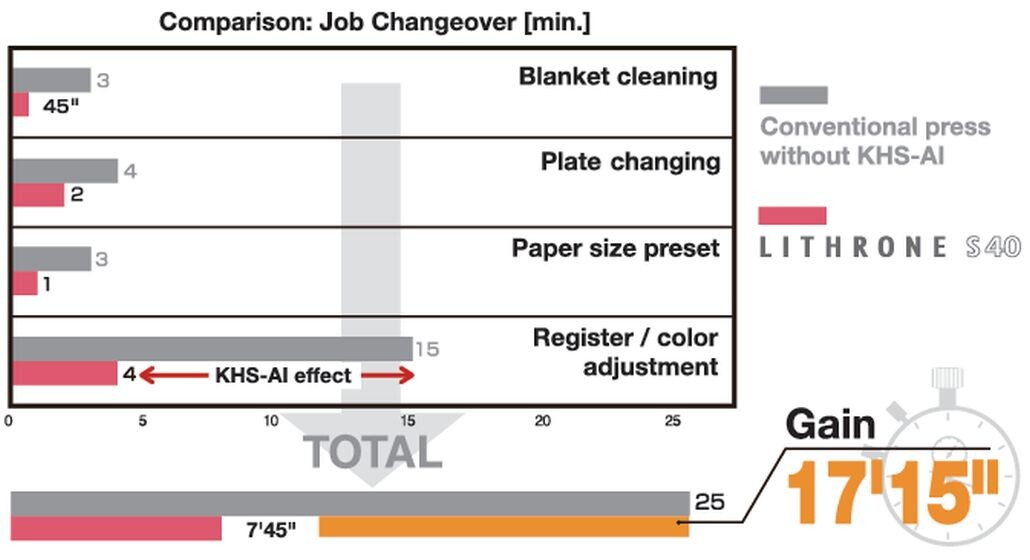
Print makeready time reduction effects at the time of development of the Lithrone S40.
Completion of KHS enables first-pull register and color matching
The APC and AMR functions discussed above reduced the time required for mechanical changeovers, but in actual printing operations, the trial printing time before the start of production printing for the next job is downtime, and to improve productivity, matching the target density and appropriate color to color registration were essential. In addition, to achieve the target density, technology that could form an ink film thickness corresponding to the print image was needed, and to adjust the color to color registration, precision of image position on the plate, U-cut precision, and precision of the setting to the register pin using APC were also important. During printing, color to color registration and density adjustment are particularly important and since registration accuracy had been improved with APC at the core, the next requirement was a system that could speed up density adjustment. The reason for this was that unless these two functions are in place, ultimately there can be no improvement in productivity or reduction in overall paper waste. Following repeated research into systems that meet these two needs, Komori completed the Komori High-performance System (KHS) through industry-academia collaboration with the Japan Printing Academy in 1997. The KHS can complete register adjustment and density adjustment during print makeready in one shot, a world's first. As a productivity improvement support system compatible with the digitalization of printing, KHS introduced innovations to the standardization of register adjustment and density adjustment operation based on the printing image area ratio data from PCC (PQC CIP Communicator) software, which existed as a key item for the use of PPF data from CIP3. It achieved substantial reductions in print makeready time and paper waste by enabling quick startup when printing. This development opened a path to on-demand printing, which made it possible to supply the necessary number of copies when needed, regardless of the print lot size.
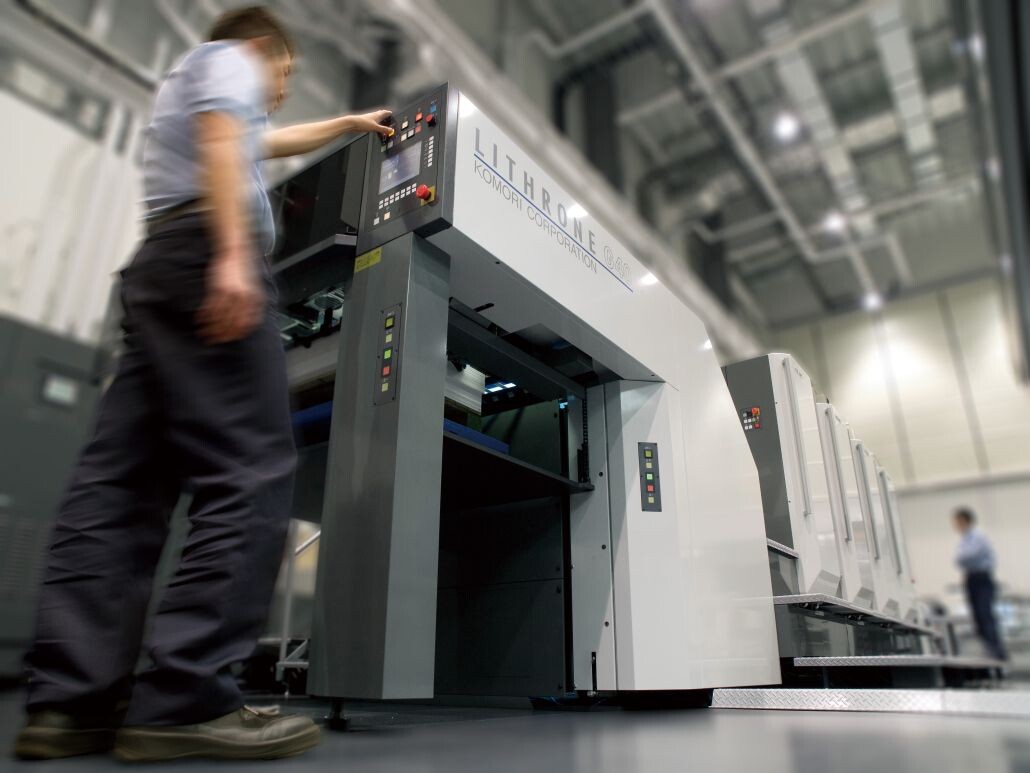
Komori also developed KHS with a first-pull accurate folding setting function for webfed offset presses, and in 2002 announced the Komori High-performance System Advanced Interface with self-learning function (KHS-AI), an advanced version. Before this, operators at each printing company had to make intuitive color adjustments according to various printing standards, but the KHS-AI was an innovative system that records data relating to color changes, such as fine adjustments of color, ambient temperature, and humidity, and makes optimal corrections through self-learning. Furthermore, by combining this with a production management system that records printing press operation and monitors progress, productivity was substantially increased. The environmentally friendly KHS-AI paper waste reduction technology was highly evaluated and won the Clean Japan Center Chairman's Award and the Technology Award from the Japanese Society of Printing Science and Technology.
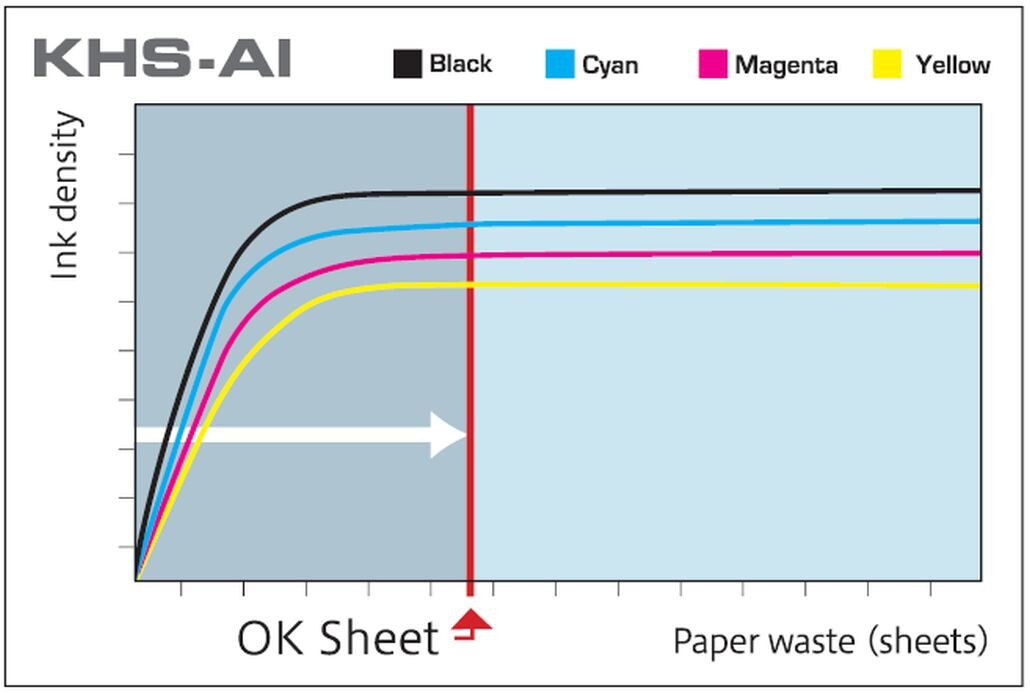
Reduction in paper waste and shortening of startup time achieved by KHS-AI.
Color adjustment management system compatible with the digitalization of printing
Digitalization rapidly advanced in the printing industry starting in the 1990s. In conjunction with this, the enhancement of color management system (CMS) became an issue. On actual printing presses, it is particularly necessary to perform numerical control to determine whether the colors created by the KHS-AI mentioned above have the required density and color values and whether uniform amounts of ink are being supplied to the left and right. Komori developed a device that uses a scanning spectrophotometer to measure the color bar placed in the margins of printed paper. The Print Density Control-Spectro (PDC-S) is a system integrated with an operating console that measures the density and color values of printed paper with high precision. By using the system, it is possible to perform management based on color differences (Delta E) calculated using density values based on spectral reflectance as well as LAB values and other data, rather than the earlier measurement method using a densitometry. Of course, a closed-loop feedback function for correcting ink key opening according to the color bar reading values substantially improved precision based on extensive field results. When combined with KHS-AI, this system can confirm the status of color matching against standard values and correct color using automatic color measurements rather than visual perception, thereby reducing paper waste, ensuring traceable print quality based on numerical data, and achieving standardization.
Furthermore, utilizing this PDC-S spectrophotometric technology, the K-ColorProfiler (Komori Color Profile Creation System) was developed to read profile creation charts at high speed and create ICC profiles, the basic element of color management. The purpose of this system is to speedily create ICC profiles. To achieve this, Komori continued to make improvements to minimize the size of measurement spots and to fit color bars and profile charts within the sheet margins to the extent possible (at that time, almost no margins were set in Japan, and as a result, these types of improvement measures were implemented to increase use frequency).
The K-ColorProfiler made it easy to prepare profile data, and as color simulation technology advanced, it had the effect of replacing earlier high-end direct digital color proofing (DDCP) devices and enabling the use of simple inkjet printers for color proofing. The PDC-S was upgraded to the PDC-SII, which supports automatic detection and high-speed measurement of color bar, and the low-priced PDCLITE II as well as the next-generation PDC-SX, which improved functions to a system that operates on both the lateral and longitudinal axes. Later, the PDC-SX was equipped with a scanner that can read the entire printed image, and an optional PDF authentication function was developed to compare and verify the image data (PDF data) used for plate making against the actual printed image.
In this way, Komori developed automation and labor-saving devices around printing presses while adopting the customer's perspective at all times.
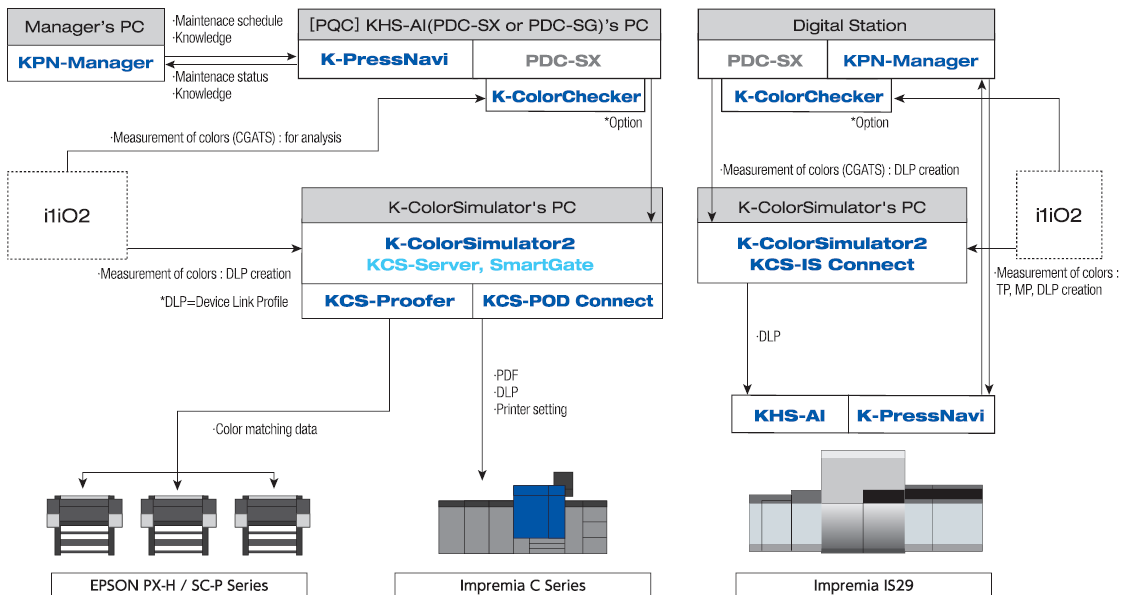
System relationship diagram of the Komori CMS solutions in 2018 * Sales models and their specifications may differ according to the country and the region.