The Challenge of Digital Networks
“Technology and Challenges as Seen Through Komori’s 100-Year History” Series (Part 5)
29 July 2026
In this series, "Technologies and Challenges Through 100 Years of Komori," we spotlight key technological innovations and business milestones from our century-long history. This article explores Komori's challenge of building a digital network--an initiative undertaken to address the industry's pressing issues of labor shortages and declining demand.
As Japan's working-age population (aged 15-64) steadily declined following its peak in 1995, the printing industry grappled with a severe labor shortage and a downturn in domestic demand.
Concurrently, an international cooperative organization was established to promote the standardization of linked data between printing processes and the unification of data formats.
In an era driven by digital connectivity, technological innovation aimed at meeting this demand was an urgent imperative.
A milestone for the coming era
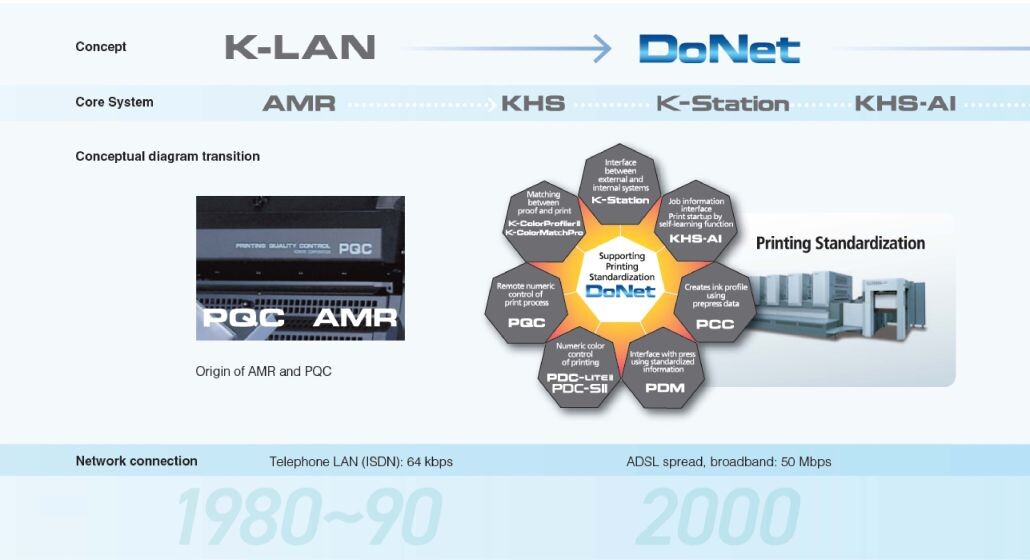
Komori embarked on digital system development as early as the 1980s, aligning with the rising prevalence of network-based data exchange.
Utilizing a local area network known as K-LAN, which utilized telephone lines, Komori pioneered the development of a comprehensive management system. This system seamlessly integrated the Automatic Make-Ready (AMR) system, Print Quality Control (PQC) system, and printing presses. Encountering challenges such as transmission speed limitations relative to data capacity and the configuration of control schemes using control systems or sequencers installed in printing presses, Komori needed a holistic approach to address these issues. Today, many aspects of the system are controlled by electrical control systems, leveraging motors and air control.
Birth of DoNet
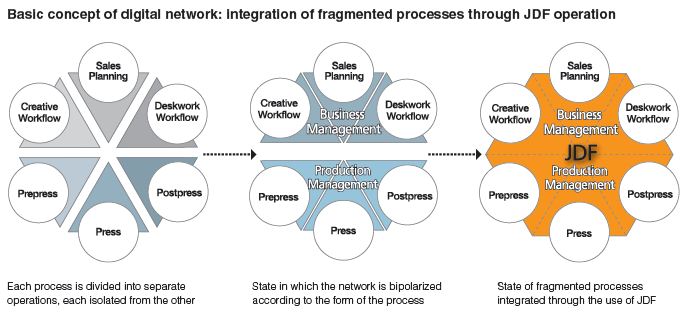
Recognizing the pivotal role of Smart Factories in the evolution of printing companies, Komori unveiled DoNet (Digital Open Architecture Network) at drupa 2000. DoNet represents a platform meticulously designed to integrate seamlessly with future digitalization trends. This innovative digital workflow concept is engineered to support the unique standardization of printing embraced by a printing press manufacturer, with a keen focus on digital high-performance printing presses.
DoNet's workflow revolves around two core pillars: data management, which prioritizes data integration and management, and color management, aimed at standardizing print quality. In a comprehensive design, both prepress and postpress operations, including products from other companies, are integrated with these two pillars.
In terms of integration with prepress and postpress operations, DoNet stands out for its state-of-the-art JDF connectivity. It has undergone interoperability testing with numerous specialized manufacturers and vendors, underscoring Komori's commitment to an open architecture philosophy that prioritizes seamless integration within the customer's environment.
Originally, at the heart of DoNet resided the K-Station, acting as a pivotal data bridge, complemented by the KHS aimed at enhancing printing press efficiency. Additionally, the lineup included the PDC-S series and the K-ColorMatchPro/K-ColorProfiler (modules of Komori Color Management System), pivotal in standardizing printing quality by matching color reproduction between proofs and final prints.
Drafted to receive job data and preset data from K-Station via a network, KHS stands as an innovative productivity-enhancing system. Engineered to minimize job changeover times and virtually eliminate paper losses, it facilitates near-zero downtime. The calculated preset data enabled first-pull register accuracy and color matching.
Subsequently, Komori unveiled KHS-AI, an advanced iteration built upon the foundation of KHS.
By establishing a digital workflow anchored on these systems, Komori was able to streamline the work-in-process period, enhance productivity, elevate quality standards, and strategically allocate investments to meet customer demands. These proactive approaches fostered a smoother transition to a Smart Factory.
Evolution of the core K-Station
During IGAS '99, Komori introduced the K-Station as the cornerstone of DoNet. Acting as a centralized management system for multiple Komori printing presses, it also functions as an interface to external MIS (Management Information System) and software for handling printing production data through CIP4/JDF standards.
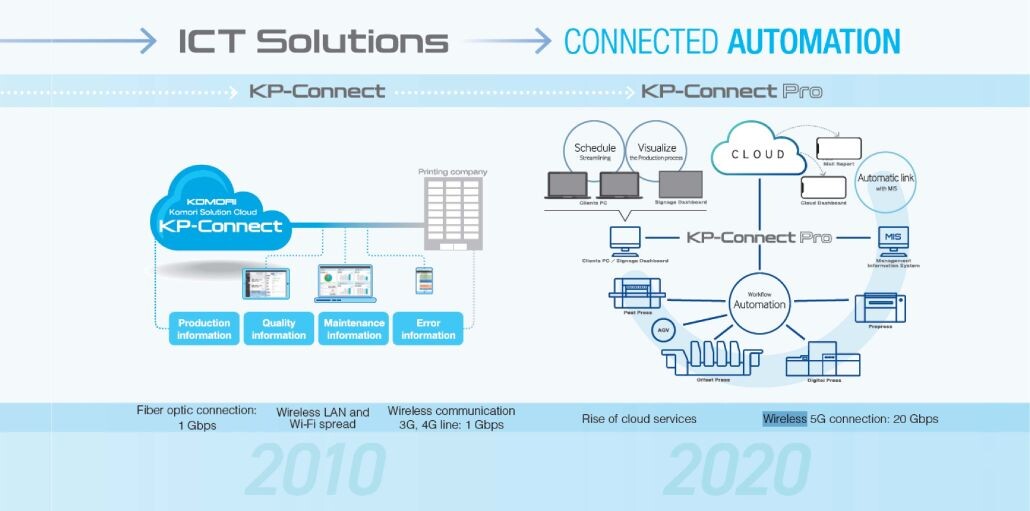
Building upon the foundational concept and design of the K-Station, the KP-Connect, unveiled at IGAS 2015, represents an evolution tailored for the IoT era of printing companies in the internet age.
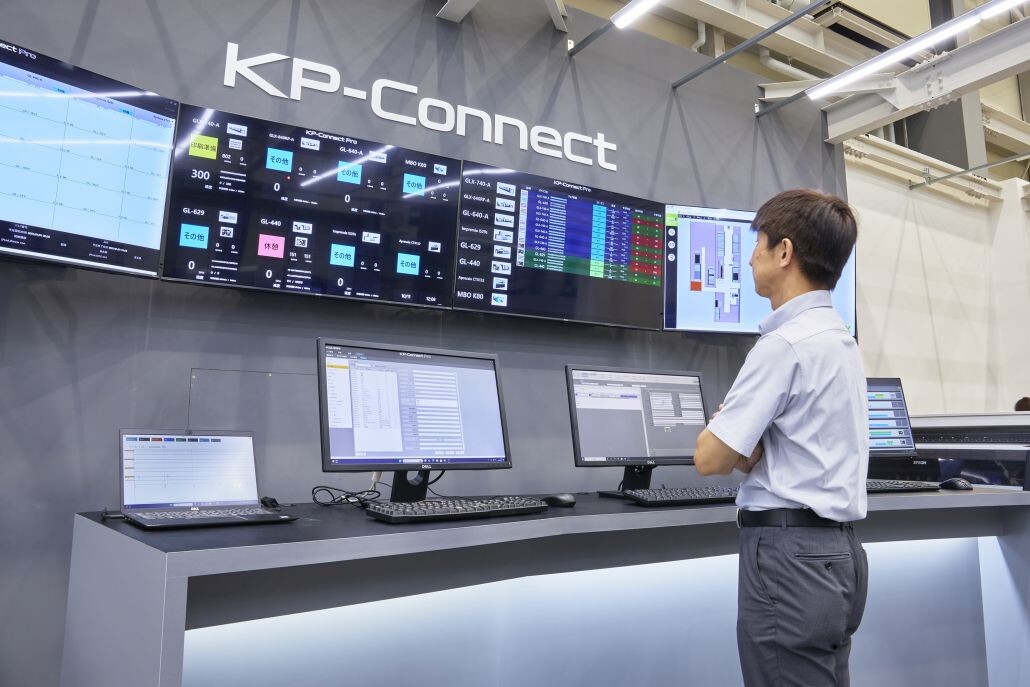
KP-Connect symbolizes the seamless link (Connect) between the Company (K = Komori) and printing companies (P = Printing Company). With the growing prevalence of digital printing data exchange and networking, KP-Connect leverages cloud technology to enable real-time monitoring of printing press operations from any location.
In light of continuous advancements in network speed and cloud computing, KP-Connect Pro expands connectivity to additional manufacturers, vendors, and existing machinery.
Realization of Smart Factory through Connected Automation
In 2016, Komori introduced the Komori ICT Solutions concept, leveraging cutting-edge ICT technology to connect equipment, work processes, and personnel. Building upon this foundation, in 2018, Komori embraced Connected Automation, taking the integration one step further. By unifying customers' offset printing presses, digital printing systems, prepress, and postpress operations through KP-Connect Pro, it aims to maximize labor productivity through visualization, automation, and rectification.
In 2022, Komori proposed the Smart Factory concept for the printing industry. This visionary approach incorporates automated guided vehicles (AGVs) and robotics for printing sheet transfer between processes alongside highly efficient machines equipped with labor-saving technologies. By seamlessly connecting all printing processes into a cohesive, one-stop production system, this initiative promises to significantly enhance production efficiency.
In March 2023, Komori unveiled the development and deployment of the KP-Connect API (Application Programming Interface), extending integration capabilities to a broader spectrum of processing stages and industries beyond printing, including logistics. Overcoming challenges in JDF integration, this advancement enables seamless data sharing via the cloud, facilitating collaboration with allied companies and suppliers to devise innovative solutions for customers.
Driven by the vision of Connected Automation, Komori seeks to revolutionize its customers' approach to production site operations. Moving beyond the traditional problem-solving mindset of "how to create," the focus shifts to "what to create," ushering in a new era of productivity and value creation. This strategic evolution is poised to redefine the printing industry landscape as a whole.